- Mary Faustina Kowalska
- The miracle of Maureen Dignan
- Homily of the Holy Father for her beatification
- Homily of the Holy Father for her canonization
- Mary Faustina Kowalska
|
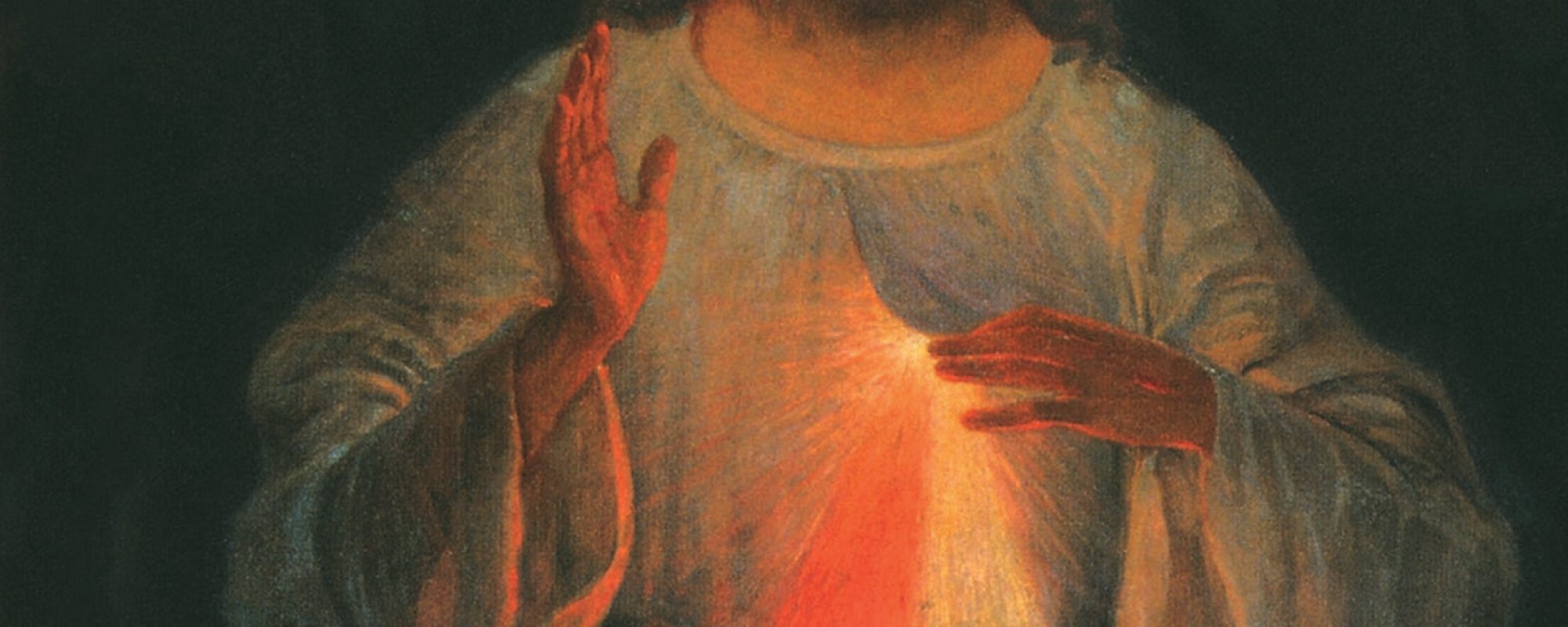
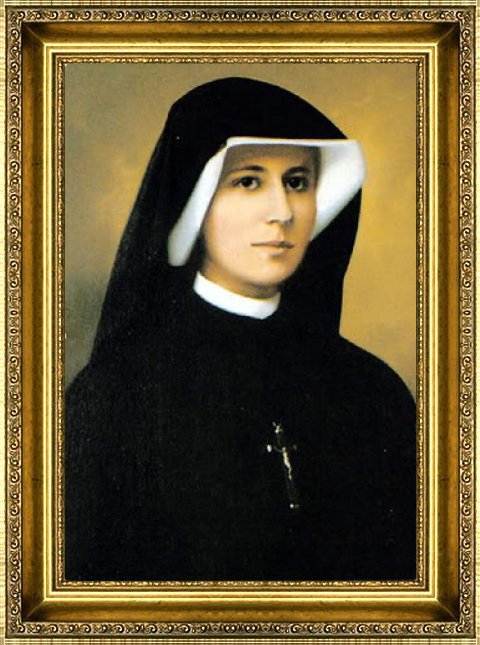
MARY FAUSTINA KOWALSKA 1905-1938 Sister Mary Faustina, an apostle of the Divine Mercy, belongs today to the group of the most popular and well-known saints of the Church. Through her the Lord Jesus communicates to the world the great message of God’s mercy and reveals the pattern of Christian perfection based on trust in God and on the attitude of mercy toward one’s neighbors. She was born on August 25, 1905 in G»ogowiec in Poland of a poor and religious family of peasants, the third of ten children. She was baptized with the name Helena in the parish Church of Ðwinice Warckie. From a very tender age she stood out because of her love of prayer, work, obedience, and also her sensitivity to the poor. At the age of nine she made her first Holy Communion living this moment very profoundly in her awareness of the presence of the Divine Guest within her soul. She attended school for three years. At the age of sixteen she left home and went to work as a housekeeper in Aleksandrów, ºódï and Ostrówek in order to find the means of supporting herself and of helping her parents. At the age of seven she had already felt the first stirrings of a religious vocation. After finishing school, she wanted to enter the convent but her parents would not give her permission. Called during a vision of the Suffering Christ, on August 1, 1925 she entered the Congregation of the Sisters of Our Lady of Mercy and took the name Sister Mary Faustina. She lived in the Congregation for thirteen years and lived in several religious houses. She spent time at Kraków, P»ock and Vilnius, where she worked as a cook, gardener and porter. Externally nothing revealed her rich mystical interior life. She zealously performed her tasks and faithfully observed the rule of religious life. She was recollected and at the same time very natural, serene and full of kindness and disinterested love for her neighbor. Although her life was apparently insignificant, monotonous and dull, she hid within herself an extraordinary union with God. It is the mystery of the Mercy of God which she contemplated in the word of God as well as in the everyday activities of her life that forms the basis of her spirituality. The process of contemplating and getting to know the mystery of God’s mercy helped develop within Sr. Mary Faustina the attitude of child-like trust in God as well as mercy toward the neighbors. O my Jesus, each of Your saints reflects one of Your virtues; I desire to reflect Your compassionate heart, full of mercy; I want to glorify it. Let Your mercy, O Jesus, be impressed upon my heart and soul like a seal, and this will be my badge in this and the future life (Diary 1242). Sister Faustina was a faithful daughter of the Church which she loved like a Mother and a Mystic Body of Jesus Christ. Conscious of her role in the Church, she cooperated with God’s mercy in the task of saving lost souls. At the specific request of and following the example of the Lord Jesus, she made a sacrifice of her own life for this very goal. In her spiritual life she also distinguished herself with a love of the Eucharist and a deep devotion to the Mother of Mercy. The years she had spent at the convent were filled with extraordinary gifts, such as: revelations, visions, hidden stigmata, participation in the Passion of the Lord, the gift of bilocation, the reading of human souls, the gift of prophecy, or the rare gift of mystical engagement and marriage. The living relationship with God, the Blessed Mother, the Angels, the Saints, the souls in Purgatory — with the entire supernatural world — was as equally real for her as was the world she perceived with her senses. In spite of being so richly endowed with extraordinary graces, Sr. Mary Faustina knew that they do not in fact constitute sanctity. In her Diary she wrote: Neither graces, nor revelations, nor raptures, nor gifts granted to a soul make it perfect, but rather the intimate union of the soul with God. These gifts are merely ornaments of the soul, but constitute neither its essence nor its perfection. My sanctity and perfection consist in the close union of my will with the will of God (Diary 1107). The Lord Jesus chose Sr. Mary Faustina as the Apostle and “Secretary” of His Mercy, so that she could tell the world about His great message. In the Old Covenant — He said to her —I sent prophets wielding thunderbolts to My people. Today I am sending you with My mercy to the people of the whole world. I do not want to punish aching mankind, but I desire to heal it, pressing it to My Merciful Heart (Diary 1588). The mission of Sister Mary Faustina consists in 3 tasks: – reminding the world of the truth of our faith revealed in the Holy Scripture about the merciful love of God toward every human being. – Entreating God’s mercy for the whole world and particularly for sinners, among others through the practice of new forms of devotion to the Divine Mercy presented by the Lord Jesus, such as: the veneration of the image of the Divine Mercy with the inscription: Jesus, I Trust in You, the feast of the Divine Mercy celebrated on the first Sunday after Easter, chaplet to the Divine Mercy and prayer at the Hour of Mercy (3 p.m.). The Lord Jesus attached great promises to the above forms of devotion, provided one entrusted one’s life to God and practiced active love of one’s neighbor. – The third task in Sr. Mary Faustina’s mission consists in initiating the apostolic movement of the Divine Mercy which undertakes the task of proclaiming and entreating God’s mercy for the world and strives for Christian perfection, following the precepts laid down by the Blessed Sr. Mary Faustina. The precepts in question require the faithful to display an attitude of child-like trust in God which expresses itself in fulfilling His will, as well as in the attitude of mercy toward one’s neighbors. Today, this movement within the Church involves millions of people throughout the world; it comprises religious congregations, lay institutes, religious, brotherhoods, associations, various communities of apostles of the Divine Mercy, as well as individual people who take up the tasks which the Lord Jesus communicated to them through Sr. Mary Faustina. The mission of the Blessed Sr. Mary Faustina was recorded in her Diary which she kept at the specific request of the Lord Jesus and her confessors. In it, she recorded faithfully all of the Lord Jesus’ wishes and also described the encounters between her soul and Him. Secretary of My most profound mystery — the Lord Jesus said toSr. Faustina — know that your task is to write down everything that I make known to you about My mercy, for the benefit of those who by reading these things will be comforted in their souls and will have the courage to approach Me (Diary 1693). In an extraordinary way, Sr. Mary Faustina’s work sheds light on the mystery of the Divine Mercy. It delights not only the simple and uneducated people, but also scholars who look upon it as an additional source of theo-logical research. The Diary has been translated into many languages, among others, English, German, Italian, Spanish, French, Portuguese, Arabic, Russian, Hungarian, Czech and Slovak. Sister Mary Faustina, consumed by tuberculosis and by innumerable sufferings which she accepted as a voluntary sacrifice for sinners, died in Krakow at the age of just thirty three on October 5, 1938 with a reputation for spiritual maturity and a mystical union with God. The reputation of the holiness of her life grew as did the cult to the Divine Mercy and the graces she obtained from God through her intercession. In the years 1965-67, the investigative Process into her life and heroic virtues was undertaken in Krakow and in the year 1968, the Beatification Process was initiated in Rome. The latter came to an end in December 1992. On April 18, 1993 our Holy Father John Paul II raised Sister Faustina to the glory of the altars. Sr. Mary Faustina’s remains rest at the Sanctuary of the Divine Mercy in Kraków-ºagiewniki.
|
http://www.vatican.va/news_services/liturgy/documents/ns_lit_doc_20000430_faustina_en.html
- The miracle of Maureen Dignan
In 1981, at the tomb of Sr. Maria Faustina Kowalska in Poland, Maureen Digan experienced a healing from incurable Milroy’s disease. Her healing was deemed a miracle through the intercession of Sr. Faustina, which led to Faustina’s beatification in 1993. Maureen and her husband, Deacon Bob Digan, of Lee, Massachusetts, have released a DVD, “In the Name of Miracles,” which tells their story
Before the age of 15, Maureen Digan enjoyed a normal healthy life as an active teenager. Then suddenly, she was struck down with a slowly progressive but terminal disease called Lymphedema. It is a serious cancer which causes massive swelling of the limbs.
This painful disease is caused by a blockage which prevents fluid from draining and as the fluid builds up, the swelling continues. There’s no cure but it can be controlled with diligent care. Unfortunately, it does not respond to medication and does not go into remission.
During the next ten years, Maureen had about fifty operations and had lengthy confinements in hospital for up to a year at a time. Friends and relations suggested she should pray and put her trust in God. But Maureen could not understand why God had allowed her to get this disease in the first place and had lost her faith completely. Eventually the doctors decided that because of her deteriorating condition, it was necessary to amputate her leg. They then proceeded to set a date for the second operation of the other leg.
But, one evening while Maureen was in hospital, her husband Bob went to see a film called “Divine Mercy – No Escape”. After seeing this film on the life of Sr. Faustina, he became convinced of the healing powers through the intercession of a Saint. Bob persuaded Maureen and the doctors that she should go with him to the tomb of Sr. Faustina in Poland.
They arrived in Poland on 23rd March 1981 and Maureen went to confession for the first time since she was a young girl. At the tomb, then called the Shrine of Sr. Faustina, Maureen remembers saying in her own inimitable style, “O.K. Faustina I came a long way, now do something”.
In her heart she heard Sr. Faustina say “If you ask for my help, I will give it to you”. Maureen thought she was having a nervous breakdown. All of a sudden, the pain seemed to drain out of her body and her swollen leg which was due to be amputated shortly, went back to its normal size.
When she returned to the U.S.A. she was examined by five independent doctors who came to the conclusion that she was completely healed. They had no medical explanation for the sudden healing of this incurable disease. The accumulated evidence for this miracle was examined in consultation by five doctors appointed by the Sacred Congregation for the Causes of Saints. Having passed this test, it was examined by a team of theologians, and finally by a team of cardinals and bishops.
The cure was accepted by all as a miracle caused by Sr. Faustina’s intercession to Divine Mercy. Sr. Faustina was beatified on 18th April 1993 and canonised in April 2000 by Pope John Paul II.
- Homily of the Holy Father for her beatification
On Mercy Sunday, April 18, 1993, Saint Faustina was beatified by Pope John Paul II in St. Peter’s Square. He began his homily with a quotation from her diary: “I clearly feel that my mission does not end with death, but begins”.
April 18, 1993
- Homily of the Holy Father for her canonization
HOMILY OF THE HOLY FATHER
MASS IN ST PETER’S SQUARE FOR THE CANONIZATION
OF SR MARY FAUSTINA KOWALSKA
Sunday, 30 April 2000
1. “Confitemini Domino quoniam bonus, quoniam in saeculum misericordia eius”; “Give thanks to the Lord for he is good; his steadfast love endures for ever” (Ps 118: 1). So the Church sings on the Octave of Easter, as if receiving from Christ’s lips these words of the Psalm; from the lips of the risen Christ, who bears the great message of divine mercy and entrusts its ministry to the Apostles in the Upper Room: “Peace be with you. As the Father has sent me, even so I send you…. Receive the Holy Spirit. If you forgive the sins of any, they are forgiven; if you retain the sins of any, they are retained” (Jn 20: 21-23).
Before speaking these words, Jesus shows his hands and his side. He points, that is, to the wounds of the Passion, especially the wound in his heart, the source from which flows the great wave of mercy poured out on humanity. From that heart Sr Faustina Kowalska, the blessed whom from now on we will call a saint, will see two rays of light shining from that heart and illuminating the world: “The two rays”, Jesus himself explained to her one day, “represent blood and water” (Diary, Libreria Editrice Vaticana, p. 132).
2. Blood and water! We immediately think of the testimony given by the Evangelist John, who, when a solider on Calvary pierced Christ’s side with his spear, sees blood and water flowing from it (cf. Jn 19: 34). Moreover, if the blood recalls the sacrifice of the Cross and the gift of the Eucharist, the water, in Johannine symbolism, represents not only Baptism but also the gift of the Holy Spirit (cf. Jn 3: 5; 4: 14; 7: 37-39).
Divine Mercy reaches human beings through the heart of Christ crucified: “My daughter, say that I am love and mercy personified”, Jesus will ask Sr Faustina (Diary, p. 374). Christ pours out this mercy on humanity though the sending of the Spirit who, in the Trinity, is the Person-Love. And is not mercy love’s “second name” (cf. Dives in misericordia, n. 7), understood in its deepest and most tender aspect, in its ability to take upon itself the burden of any need and, especially, in its immense capacity for forgiveness?
Today my joy is truly great in presenting the life and witness of Sr Faustina Kowalska to the whole Church as a gift of God for our time. By divine Providence, the life of this humble daughter of Poland was completely linked with the history of the 20th century, the century we have just left behind. In fact, it was between the First and Second World Wars that Christ entrusted his message of mercy to her. Those who remember, who were witnesses and participants in the events of those years and the horrible sufferings they caused for millions of people, know well how necessary was the message of mercy.
Jesus told Sr Faustina: “Humanity will not find peace until it turns trustfully to divine mercy” (Diary, p. 132). Through the work of the Polish religious, this message has become linked for ever to the 20th century, the last of the second millennium and the bridge to the third. It is not a new message but can be considered a gift of special enlightenment that helps us to relive the Gospel of Easter more intensely, to offer it as a ray of light to the men and women of our time.
3. What will the years ahead bring us? What will man’s future on earth be like? We are not given to know. However, it is certain that in addition to new progress there will unfortunately be no lack of painful experiences. But the light of divine mercy, which the Lord in a way wished to return to the world through Sr Faustina’s charism, will illumine the way for the men and women of the third millennium.
However, as the Apostles once did, today too humanity must welcome into the upper room of history the risen Christ, who shows the wounds of his Crucifixion and repeats: Peace be with you! Humanity must let itself be touched and pervaded by the Spirit given to it by the risen Christ. It is the Spirit who heals the wounds of the heart, pulls down the barriers that separate us from God and divide us from one another, and at the same time, restores the joy of the Father’s love and of fraternal unity.
4. It is important then that we accept the whole message that comes to us from the word of God on this Second Sunday of Easter, which from now on throughout the Church will be called “Divine Mercy Sunday”. In the various readings, the liturgy seems to indicate the path of mercy which, while re-establishing the relationship of each person with God, also creates new relations of fraternal solidarity among human beings. Christ has taught us that “man not only receives and experiences the mercy of God, but is also called “to practise mercy’ towards others: “Blessed are the merciful, for they shall obtain mercy’ (Mt 5: 7)” (Dives in misericordia, n. 14). He also showed us the many paths of mercy, which not only forgives sins but reaches out to all human needs. Jesus bent over every kind of human poverty, material and spiritual.
His message of mercy continues to reach us through his hands held out to suffering man. This is how Sr Faustina saw him and proclaimed him to people on all the continents when, hidden in her convent at £agiewniki in Kraków, she made her life a hymn to mercy: Misericordias Domini in aeternum cantabo.
5. Sr Faustina’s canonization has a particular eloquence: by this act I intend today to pass this message on to the new millennium. I pass it on to all people, so that they will learn to know ever better the true face of God and the true face of their brethren.
In fact, love of God and love of one’s brothers and sisters are inseparable, as the First Letter of John has reminded us: “By this we know that we love the children of God, when we love God and obey his commandments” (5: 2). Here the Apostle reminds us of the truth of love, showing us its measure and criterion in the observance of the commandments.
It is not easy to love with a deep love, which lies in the authentic gift of self. This love can only be learned by penetrating the mystery of God’s love. Looking at him, being one with his fatherly heart, we are able to look with new eyes at our brothers and sisters, with an attitude of unselfishness and solidarity, of generosity and forgiveness. All this is mercy!
To the extent that humanity penetrates the mystery of this merciful gaze, it will seem possible to fulfil the ideal we heard in today’s first reading: “The community of believers were of one heart and one mind. None of them ever claimed anything as his own; rather everything was held in common” (Acts 4: 32). Here mercy gave form to human relations and community life; it constituted the basis for the sharing of goods. This led to the spiritual and corporal “works of mercy”. Here mercy became a concrete way of being “neighbour” to one’s neediest brothers and sisters.
6. Sr Faustina Kowalska wrote in her Diary: “I feel tremendous pain when I see the sufferings of my neighbours. All my neighbours’ sufferings reverberate in my own heart; I carry their anguish in my heart in such a way that it even physically destroys me. I would like all their sorrows to fall upon me, in order to relieve my neighbour” (Diary, p. 365). This is the degree of compassion to which love leads, when it takes the love of God as its measure!
It is this love which must inspire humanity today, if it is to face the crisis of the meaning of life, the challenges of the most diverse needs and, especially, the duty to defend the dignity of every human person. Thus the message of divine mercy is also implicitly a message about the value of every human being. Each person is precious in God’s eyes; Christ gave his life for each one; to everyone the Father gives his Spirit and offers intimacy.
7. This consoling message is addressed above all to those who, afflicted by a particularly harsh trial or crushed by the weight of the sins they committed, have lost all confidence in life and are tempted to give in to despair. To them the gentle face of Christ is offered; those rays from his heart touch them and shine upon them, warm them, show them the way and fill them with hope. How many souls have been consoled by the prayer “Jesus, I trust in you”, which Providence intimated through Sr Faustina! This simple act of abandonment to Jesus dispels the thickest clouds and lets a ray of light penetrate every life. Jezu, ufam tobie.
8. Misericordias Domini in aeternum cantabo (Ps 88 [89]: 2). Let us too, the pilgrim Church, join our voice to the voice of Mary most holy, “Mother of Mercy”, to the voice of this new saint who sings of mercy with all God’s friends in the heavenly Jerusalem.
And you, Faustina, a gift of God to our time, a gift from the land of Poland to the whole Church, obtain for us an awareness of the depth of divine mercy; help us to have a living experience of it and to bear witness to it among our brothers and sisters. May your message of light and hope spread throughout the world, spurring sinners to conversion, calming rivalries and hatred and opening individuals and nations to the practice of brotherhood. Today, fixing our gaze with you on the face of the risen Christ, let us make our own your prayer of trusting abandonment and say with firm hope: Christ Jesus, I trust in you! Jezu, ufam tobie!
 Misericorde Divine International Association
You must be logged in to post a comment.